
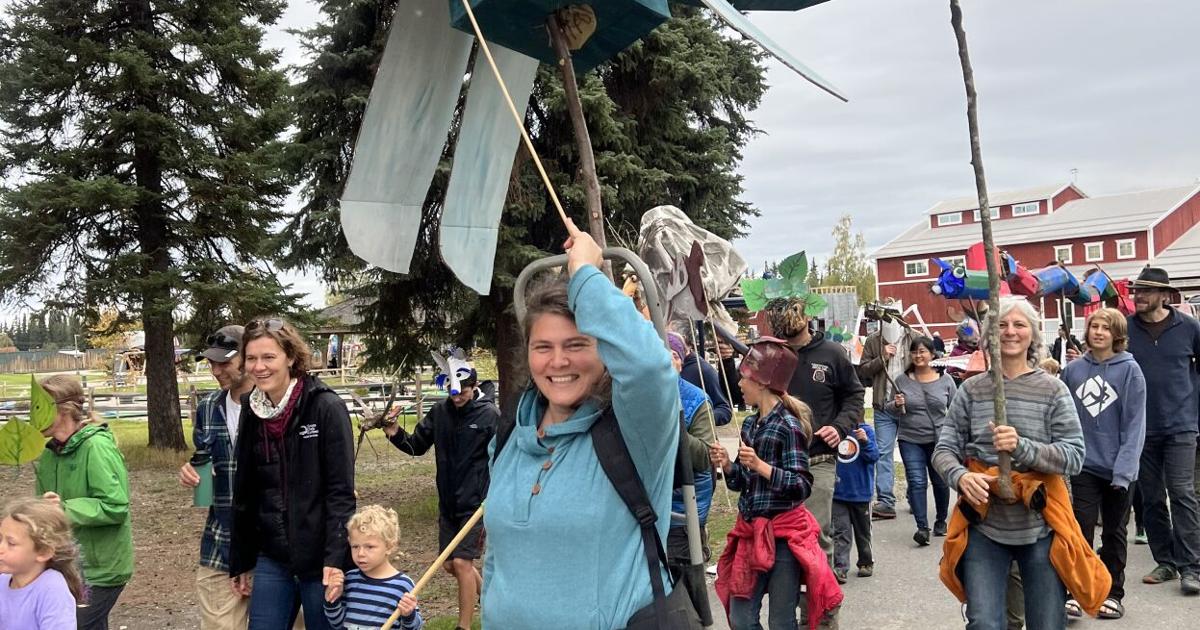
Art, science, and culture all collided joyfully in one week, giving birth to the first annual Arctic Fest.
From the massive Fungi Festival at Ester Community Park to a sold-out performance by the Inuit soul music group Pumyua by the Fairbanks Concert Association, communities have embraced the concept of coming together to tackle climate change.
The Boreal Forest was the focus of a major art exhibition, In A Time of Change, as well as a doll-making class. Puppeteers of all ages were invited to create puppets from recycled materials representing ‘Boreal Forest: The Little Things That Matter’. There were mosquito puppets and mushroom puppets created in some workshops.
A giant handcrafted dragonfly puppet hoisted high overhead led a line of colorful creations as puppets and puppet makers made their way through Pioneer Park during the celebratory puppet parade.
This was just one of many events.
Fairbanks Concert Association and its newly retired director Anne Biberman. Elizabeth Balster Dabney of the Northern Environment Center and Mary Beth Lee of the University of Alaska Fairbanks Institute of Arctic Biology.
This festival focuses on climate change. Three completely different organizations have helped devise different ways to address this issue. Ann Biberman said the force behind that collaboration was what made the festival so successful.
“To solve that problem is to take all these very different perspectives,” she said. “We’re really interested in fostering new innovation, positive innovation. Let’s think together.”
An indigenous perspective helps. Incorporating art helps.
“Art makes you feel,” she said. “Once you feel it, you want to act.
“Science tells us what’s going on,” she added. “But without the creative element, you can’t necessarily make that leap.”
The festival offered something for both scientists and non-scientists, adults and children.
“My big hope is that by next year, we will be offering substantial prizes to those who travel to Arctic Fest with the lowest carbon footprint,” Bieberman said. “Festivals become part of the solution and support innovation.”
Arctic Fest featured a series of presentations at the Centennial Center Theater. From representing Alaskan Natives in storytelling to promoting natural rights for the richness of the Arctic and his 400-million-year-changing future.
The Arctic Museum featured an Arctic Fest panel discussion and viewing of the Arctic collection. The Green Marketplace and Innovation Hub opened for two days at Pioneer Park’s Centennial Center Exhibition Hall.
Experts took a mushroom walk on the campus of the University of Alaska Fairbanks, and the audience enjoyed a live performance of “In A Time of Change” (ITOC) Boreal Forest Stories.
The ITOC Boreal Forest Stories art exhibition at the Bear Gallery will begin next month. More than 44 artists, authors, educators, and humanities collaborated with scientists to explore, create, and share original stories of the boreal forest.
The exhibition highlights the connection between science and art. A constant stream of fans soaked up the artwork from Friday night’s opening through Saturday, with many observers returning for his second visit.
For more information on this first annual Arctic Festival, visit www.articfest.org.
Comments
Post a Comment