
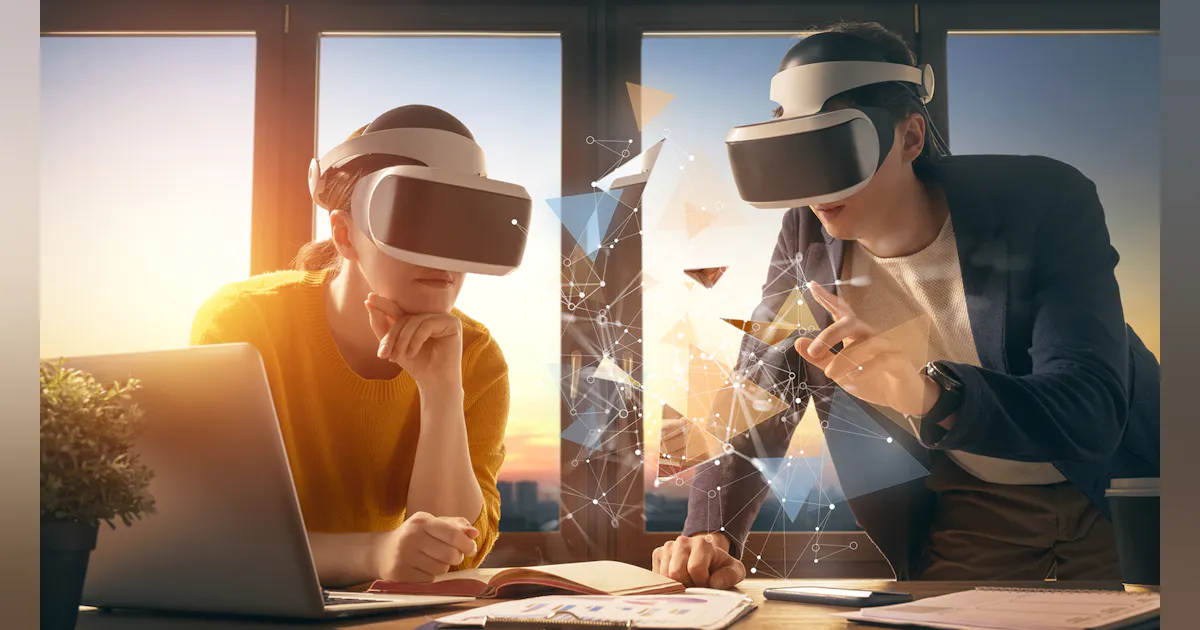
content of study:
- What technical hurdles do you have to overcome?
- The impact of position tracking and placement of virtual objects on development.
- How 3D scanning, time-of-flight and HMI solve key problems.
The Metaverse is expected to transform our very concept of virtual reality. But before we do that, there are some very real problems to solve.
Interoperability is a big issue, with numerous mega players competing to establish platforms and operating standards. Displays and optical solutions need to become more practical. Without resolving size, weight, and aesthetic issues, VR headsets will continue to be used primarily for gaming and specialized applications.
There are also technical issues that must be overcome. From a purely operational perspective, two of the biggest challenges for developers are position tracking and placement of virtual objects.
The metaverse is orders of magnitude more complex than traditional virtual environments. It includes not only worlds that are purely imaginative, but also worlds that reflect the corresponding clarity, detail and size of the real world. For the metaverse to be useful, users living in virtual environments need to know exactly where they are and where they are moving, regardless of distance or speed.
Placement of virtual objects is another important issue. Metaverse applications need to understand their surroundings in order to place items accurately. Along with positional tracking, accurate object placement becomes essential. It is not enough to have one or the other for the metaverse to be successful. Both must be achieved.
3D technology becomes important
Fortunately, hardware innovations are underway to support metaverse tracking and placement. One breakthrough area is precision scanning technology for digital reproduction, pursued through 3D scanning.
3D scanning can be achieved with depth cameras based on various technologies. For example, consider structured light. This is a technique that projects a pattern of light onto an object and reads it with a 3D imaging camera. The camera detects distortion due to distance differences and faithfully reproduces it. 3D scanning digitally reproduces people and things so that they can be inserted into virtual environments.
Another positioning innovation is 3D Time of Flight (ToF). This allows metaverse applications to track real-world objects and position them accurately as they move. ToF emits light pulses into the scene, which are reflected and read by sensors. ToF not only allows you to perceive moving objects, but also allows them to be digitally integrated into your virtual environment. It can identify everything from tools and vehicles to animals and even individuals.
Unlike LiDAR (light detection and ranging), another type of 3D scanning, ToF depth sensing cameras provide full field of view information. Conventional LiDAR uses a laser to scan from top to bottom and left to right. Generating the full field of view with LiDAR is very expensive, making it prohibitive for most metaverse applications.
Display technology is evolving to support 3D. Many types of devices that Metaverse users are expected to enjoy have been around for years. Still, most exhibit significant limitations at this time.
Google Glass and Snap Spectacles have met with mixed success at best due to cost, features, and privacy issues. And even the most advanced VR headsets have limited application areas. Popular with gamers and other niche users, it cuts off the wearer from the real world, making it difficult to interact outside of the virtual environment.
Ergonomics and security
Satisfactory performance and ergonomic standards are essential for the widespread acceptance of the Metaverse. Human Machine Interfaces (HMI), data rates, rendering, etc. are necessary to create seamless interactions with the metaverse.
For displays, most experts agree that 60 pixels per degree of field of view is the minimum required for video rendering that matches real-world conditions. This is a requirement met by the best optical devices.
Other types of HMIs will soon undergo incredible transformation as well. Just last November, Meta’s Reality Labs division showed off a prototype haptic glove with raised plastic pads that allow the wearer to “feel” the surface. Raised standards for sound, sight, and touch provide residents of the Metaverse with an increasingly immersive experience.
But even leading-edge technology makers recognize that comfort and functionality are critical to acceptance of wearable devices. VR/AR (augmented reality) eyewear needs to be light enough to wear all day long, attractive and engaging, all while offering a compelling user experience at an affordable price.
One breakthrough, called surface-relief waveguide technology, could meet this need by providing see-through waveguides on high-index glass. The solution supports imaging applications for VR and MR (mixed reality) displays, 3D sensing, and automotive heads-up displays.
Finally, developers have to deal with privacy and security issues. Data security presents challenges, but 3D scanning can help mitigate privacy risks. Unlike 2D scanners, which record facial images, 3D scanners only record anonymous data from a “point cloud” for authentication purposes. No images or other identifiable records are created.
Tightrope walking
The next few years will be a critical time for the realization of the Metaverse. Innovators can benefit by viewing this journey as a series of small steps, with each victory resting on the shoulders of the final breakthrough.
Developers must find a balance point between form factor, data quality, compute power, power consumption, and bandwidth limitations for each piece of meta hardware. Overcoming these obstacles will make the Metaverse, the ultimate virtual experience, a reality.
Comments
Post a Comment